Juxtapositions of West Virginia: From Ghost Towns to Quirky, Queer Corners
I have a feeling that West Virginia might be one of my next state obsessions outside of my homebase while working on All the Genders. It’s close to my homebase, and stunningly beautiful in its own weird and quirky way.
So much of West Virginia almost feels abandoned as signs of its declining coal industry leaving behind ghost towns are everywhere. Many of the tiny communities that are tucked away up winding, tough-to-navigate highways are still figuring out how to adapt to this rapidly changing world, yet simultaneously frozen in time.
The Heart of Appalachia
Driving up a winding road into the Monongahela National Forest, my partner mentioned that he felt like he was back in Alaska. It didn’t take long for me to feel the same way. We soon discovered through national forest signs that we were in a rare ecosystem of West Virginia that shares characteristics with the northern tundra regions I’m in love with. Thick patches of wildflowers, including fireweed, filled the high-elevation bog, making me feel like I wasn’t in West Virginia at all. A park ranger in the crowded visitor center of New River Gorge National Park had directed us further north, away from the tourists and towards his favorite natural gems. It felt like a win spending our day in the national forest that lines one of America’s most scenic byways and is nearly forgotten in the world of flashy Instagram pics.


Back in the lower elevations, lush forested hills closed in on the winding road. Maybe one out of every ten oncoming drivers drifted into our narrow driving lane, keeping us on full alert every time we left our lodging for another twisting, winding drive. Dead deer were interspersed along the non-existent shoulder, and we occasionally slammed the brakes as a live deer scrambled out of the thick brush. A woman standing in line at a convenience store doubling as a poor grocery store substitute complained that she was nearly run off the road again by a neighbor barreling down the middle in his truck. Coal mine shafts and related equipment lined the hillsides—some long abandoned, while others had fresh piles of dusty, black coal reaching towards the sky.


Explore more of these journeys – All the Genders is becoming a book.
Follow the Kickstarter prelaunch page to carry it forward.
Queer Pockets in the Old Confederacy
As for queer culture and communities in West Virginia? Well, I still have a lot to learn, and think I’ll be able to connect with more queer folks and allies here on my next trip with more networking. Outward signs of queer inclusivity seemed relatively quiet in the southern half of the state, both in the vast rural hills and the small urban pockets. Signs of the old confederacy’s values were much more visible than I was used to, even after spending years living in rural Missouri, Georgia and urban areas of Texas.

Only 20 minutes outside of Huntington, Virginia I went out a jog up a peaceful road that ran through flowering fields and lush forests hosting a cacophony of birds and insects. A property with a small mobile home boasted three massive crosses towering more than 50 feet over a serene picture of grazing horses, and a confederate flag. The same road of perhaps 10 homes hosted 3 more Confederate flags and one American flag.


A younger adult who met with me for photos told me how active queer organizations were in their small, urban pocket where West Virginia intersects with Kentucky and Ohio. I had tried contacting some of the same organizations with no luck reaching anyone yet. I chalked it up to the post-Pride month period being a time when many people check out and recover from the hustle of organizing events.
This young person expressed their personal difficulty in coding themselves to be Black, to be white, and finally feeling more comfortable when they could just openly express their queerness. I sensed a hope and optimism as they described how much their urban corner of West Virginia has changed to be more inclusive as they embraced their queer journey through grade school and college. “Sometimes boys would yell racial slurs at me across the campus, but it really wasn’t very often,” they expressed, looking entirely unconcerned. Their verbal attackers just hadn’t grown up yet. At the same time, they were mentally making plans with their partner to move to another region off the grid, or even another country that might better protect LGBTQ rights if a certain politician is elected to presidential office in 2025.
In more rural parts of West Virginia, I got to correspond with a few other queer folks briefly, but photo meet-ups were falling through with the shorter term nature of this trip and geographical limitations. One of them warmly offered to take me out on a tour of the New River Gorge later on, being a rafting guide in the area. Yes please – I’ll have more than a few excuses to come back!
Just a Few more Quirky Corners of WV
In the tiny town of New Richmond, the town’s only coffee shop on Main Street drew me in. It served more than one purpose, serving creative drinks with local names that appealed to tourists, hosting a floral shop in the back and indoor greenhouse in the front lounging area, and hosted piles of boardgames for game nights. An orange box titled Secret Hitler seemed to be the center piece game, and the baristas urged us to come back for a Secret Hitler boardgame show down the next week. Customer’s dogs were welcome in the shop, creating an inclusive atmosphere for all.


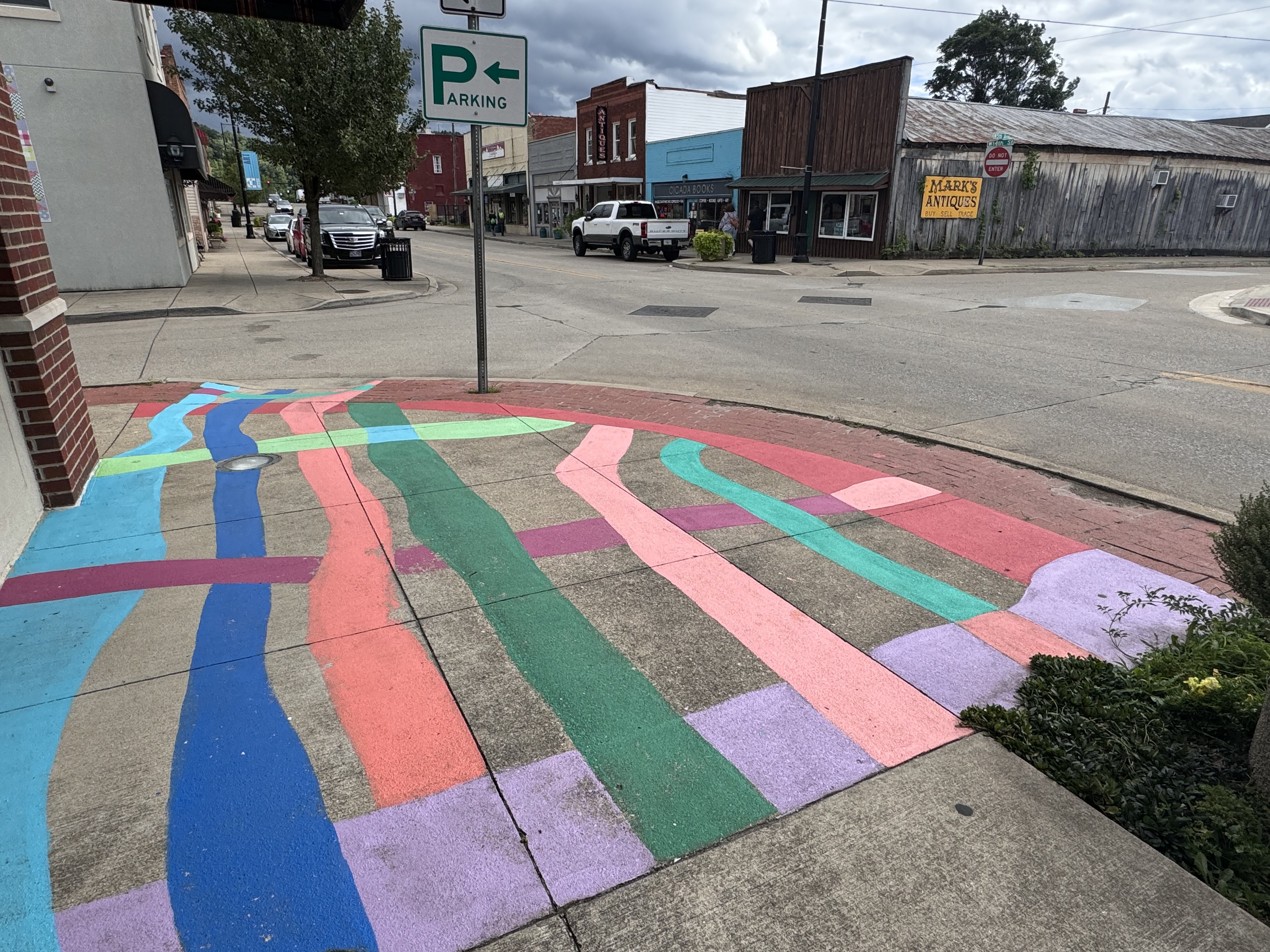
In Huntington, the downtown held both a sense of quiet eeriness, and new businesses trickling in to bring new life to the small college town. A queer ally at the only gluten-free cafe downtown excitedly pointed me towards a queer-friendly bookstore in a dusty looking historic district, and towards a quirky comic book store that is home to a life size replica of Doctor Who’s Tardis. A local art competition over the past year has brought splashes of color to the downtown grid through fiberglass versions of four local animals: the deer, bear, cardinal and brook trout.


My initial impression of this wild state was a tangle of juxtapositions. Perhaps a sense of despondence in communities that are plagued with drug use and poverty as major industries continue to leave the state. However, there’s just as much a sense of hope and fellowship that helps small rural towns survive and draws people to the few modest urban pockets along the interstate. Queer communities seem quieter here, but don’t necessarily seem like they’re hiding. West Virginia, you are wild and wonderful, and I can’t wait to come back and learn more about you.

Keep me company on my next trip to West Virginia months later, discovering more about the often inseparable queer and Appalachian identities.
Leave a Reply