How do you even begin to describe the queer community in this region? In the place that calls itself America’s 51st state without representation? It’s complicated—political, elitist, grounded, passionate, and incredibly diverse. There’s a long and scandalous queer underground history here, barely visible and ever present in influential circles. I’m struck by the complexities of political influence that brings wealth coupled with leadership, but also the isolation—people sitting on resources, unsure how or where to direct resources back into their communities that are in need. There’s so much potential for huge change here, and change is happening – fueled by defiance at the Whitehouse’s doorstep, but perhaps dampered by a sense of caution in the second wave of Trump era politics.

At the same time, I got the sense that D.C. has an incredibly strong sense of queer community, and community overall. People who are invested in their community are really invested in building and giving back to their community. The first few people I met with here also cued me into D.C. likely having the largest LGBTQ+ presence on the East Coast, with 15% of residents officially identifying as being LGBTQ+. Some speculated it was likely a lot higher, maybe 17-18% or more, with the tendency for many to be closeted working in influential circles.

D.C. has always been a city I tried to avoid—expensive, chaotic, gridlocked with traffic. It’s always this thing that seems to be in the way on road trips up and down the East coast. But this year, I find myself here not once, but twice, AND genuinely enjoying my explorations here. First in early spring, when the cherry blossoms were at their peak, and then again now, kicking off Pride Month, as the city hosts World Pride only a mere 200 miles from my homebase. I’m always behind on putting my travel impressions into coherent words, and this week am feeling the urge to essentially reset from my last trip to make room for new impressions on this Pride trip that will see D.C. flooded with queer, international travelers (hopefully… despite the travel warnings). So, here’s to diving into local perspectives and travel experiences from the cherry blossom season before I get swallowed up in World Pride happenings this week!

Cherry Blossoms and Queer Rights in Flux
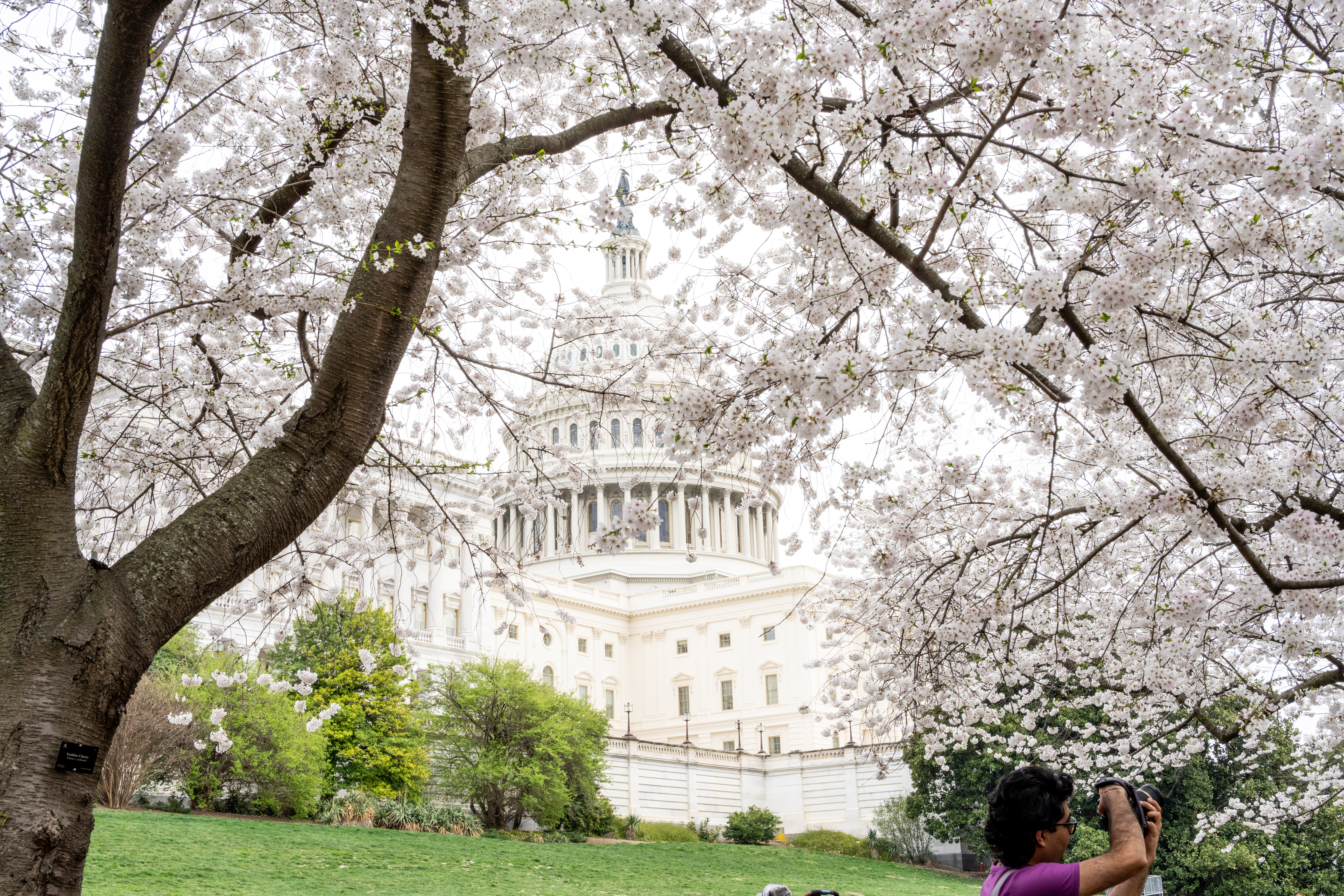
Let’s start with the cherry blossoms—because honestly, that was one of my main inspirations for visiting in March and April. The photo project and exploring queer communities has been my primary focus on most trips over the last two years, but I’m a nature nerd at heart, and sometimes plan my trips around natural phenomena like the cherry blossoms.


After getting in a few sunrise photo sessions with local queer folks and cherry blossoms during the “peak” time, a wind and thunderstorm blew through D.C. I stubbornly refused to pay $50 for an Uber ride to travel 2 miles back to the tiny apartment where I was catsitting, and opted for trekking through the howling storm across the city. The next day, one of my models showed up expecting a shoot under pink trees, finding instead mostly bare branches and soggy streets. We adjusted and adapted, deciding to collect giant magnolia petals off the ground to use in a few photos.


One of the models/storytellers I worked with for the project remarked, “if you think about it, cherry blossoms in themselves are really SO queer! This is perfect that you’re working on a queer project during peak bloom!” Not only is it the beauty of the flowers where we’re finding the “queerness.” But I think it’s also how fleeting the appreciated beauty is – as the whole world flocks to see this spectacle that only lasts a few days at its peak and a few weeks at the very most. They flank and surround the federal capitol buildings, where queer rights are simultaneously being stripped away and fought for. Then the trees fade away into the city landscape as a green staple that are still essential to the fabric of D.C.’s parks and communities the rest of the year.
So are cherry blossoms queer? I would say so – maybe similar to the fleeting moments of more easy queer visibility in history that can be so loud, then we’re transformed overnight by the chaos of the elements – things that we can’t control. There’s a scramble to adjust and continue to move on in our resiliency, AND continue to exist as we are being a core part of our communities.

A City of Wealth, Influence, and Hesitation
On my first day in D.C. I sat down with one of the owners at Spark Social – the country’s first alcoholic gay bar. It’s hard to miss, with the concrete bricks being coated in a giant rainbow. The owner has lived in D.C. for years, watching the queer community rapidly evolve. She described D.C. being behind the curve in recent history, when it comes to keeping up with other urban centers in hosting vibrantly out queer communities. “We weren’t coming together – each segment of the queer population was just doing their own thing.” This has changed more in the last decade though, as people find more power in progress together.
Progress isn’t perfect though, as queer communities shift toward being more segregated in other ways, particularly when it comes to socioeconomic status. “I know all these people with money and influence,” she told me, frustration bubbling under her words. “And I want to ask them, what are you doing with it? This city has the highest IQ in the country, and the biggest wealth disparities. There are so many people struggling, so much isolation. And I just want to shake them: you are the people who could do something.”


She tried reaching out to some friends/leaders in D.C.’s queer scene to be part of the photo project. Many of them have gone quiet. They’re scared – Visibility is rising, but so is fear. And while some folks are still living visibly and loudly, others are keeping their heads down, protecting their livelihoods, and waiting for the storm to pass.


Later that evening I went to an LGBTQ social that might be holding onto some of the 1990’s/early 2000’s vibes that the bar owner had alluded to – tight queer circles that felt closed off and elitist. The social was advertised as open to all letters of the LGBTQ, even going as far to say in the description: “we will personally greet you at the door and introduce you to new friends!” It was being co-hosted by a well known D.C. group teaming up with Dupont’s Italian Kitchen, a queer D.C. staple affectionately known as the DIK bar – upscale Italian restaurant downstairs and gay bar upstairs.


I was directed to the tucked away bar, and no one greeted me when I walked in. My first impression of the room was perhaps a small crowd of 30-40 mostly gay and bisexual men aged mid 30’s and up. Crashing the cozy bar with my awkward personality, I made eye contact with anyone who dared to look in my direction with a suspicious side-eye, and I nodded with inviting “Hi, how are you’s?” After 20 minutes of nursing my drink alone and continuing to scout the room, the last of my social energy was sapped for the day and quietly exited the bar of clique’ish feeling groups without managing to strike up one conversation. My superficial impression of the group was perhaps that of a very specific gay male stereotype – there’s no judgment here as I think there’s a lot to be said for more exclusive safe spaces. For an event that was advertised as being more inclusive of the entire queer community, the vibe didn’t work for me personally, and couldn’t help but reflect on the insights and conversations I had earlier in the day.
My first impressions of queer communities in D.C. on day 1 of this trip were interesting, but were only that – first impressions. So many queer people I met with for photos in the following week were incredibly warm and welcoming. A few of them had similar insights, saying D.C. could be tough to find your place and felt elitist, but so many people also find something really special here that strongly ties and keeps them in the District of Columbia.


Roots Beneath the Monuments
It’s easy to forget that some people are from here. D.C. is such a transient city—people coming in riding career waves of ambition, power and influence – but there are locals who grew up in the shadows of those marble buildings, creating the strongest part of D.C.’s social fabric.
Over this 10 day trip, I photographed about a dozen queer people local to the DMV area, and only one of them was born and raised in D.C. Lion suggested photos at Union Station, a public space that felt safe for them growing up amidst turmoil at home. Lion was born and raised here, and proudly talks about being a D.C. native. “There aren’t too many of us who can say that we were born and raised in D.C.” Lion’s friend, also from D.C., almost hung their head with a little bit of shame and embarrassment when I asked if they grew up here. I lightly poked at the contrasting reactions to embracing their hometown, leading Lion to gently poke at their friend, “Yeah, yeah, we’re working on that. We’re working on that. You’ve got to show some pride for where you’re from!”


Older Generations of D.C.
One of the people I photographed was an older cisgendered, lesbian woman traveling in from D.C.’s suburbs in Maryland. She has been intimately acquainted with D.C. living around this area for several decades. She opened our conversation by describing D.C. in a somewhat blunt manner: “you came here at just the right time … D.C. winters are really boring, then the city explodes with chaos and excitement when the trees turn pink in the spring, the summer is chaotic and swampy, the fall is still absolute chaos, and the winter is boring again.” The description aptly fit my past impressions of shorter D.C. visits peppered into all four seasons.

She talks about the giant leaps and bounds queer people have made in securing rights during her lifetime. She wouldn’t have been allowed to do the federal job she had (until recently) in her younger years as a woman and butch lesbian At the same time she tried to reconcile this with the queer teenagers in her life seeing their rights deteriorate. She’s working on her own photo project and gallery show (Becoming Ourselves) that involves photographing queer people to give hope to queer youth. She mulled over what the world looks like for one of the 16 year olds she photographed; queer rights have been deteriorating and eroding over most of that teenager’s life. What a strange thing to grasp when young people have so much empowering language at their disposal, and older generations are almost pitying that they are also living in a time when progress is not progress anymore – it’s regressing.


Local Politics – What does it mean to make D.C. Beautiful Again?
As I waited to get off the train for my first day back in D.C., I checked the news with my usual level of dread. What poignant timing – D.C. so briefly held the national headlines that day as yet another Executive Order got pushed out of the Whitehouse titled: “Making the District of Columbia Safe and Beautiful.”
So, what is the current “regime’s” definition of beauty in D.C.? My interpretation of the EO included eradicating all signs of poverty, homelessness and all signs of diversity that are integral to the multicultural foundation of this city. How? By using an increasing amount of force, including federal forces. By revoking home rule status (which gives the city some level of autonomy while having no political representation). By making it easier for residents to carry a lethal weapon (wait – this helps with increased safety??). Like many of these orders, it’s an ongoing question how seriously we can take it, but it sends a strong message surrounding intent. We, leaders of America, want a city at our doorstep that makes the wealthy, ruling class feel “comfortable” in an isolated bubble that doesn’t look like the rest of the country. Devoid of multicultural stripes and poverty – a dystopian vision that does not reflect America.

It gave me some food for thought as I wandered around this city and peppered people with questions about what it meant to be queer in D.C. This EO’s interpretation of urban beauty intended to optimize a manicured show for visiting world leaders, is much different than the beauty I see here. I’m seeing it in the intentionally planted pink trees that flank the White House … a historic symbol of friendship between two nations.
I’m seeing it in the person of color sitting next to me on the bus at 6AM – dressed in a pristine white jacket, pants that are too short, and sneakers barely hanging onto their soles. He’s breaking the bus’s morning code of silence by singing an enthusiastic, off key rendition of Singing for Our Lives … complete with clapping and hard stomping that was felt throughout the bus. “We’re gay and straight together, we’re together …” The bus driver joins the song with him, then laughs as she says, “you can’t go changing the words like that!”

D.C.’s beauty is in all the queer and straight folks with a rainbow full of stories and cultures. It’s in the kindness of a person I photographed working in food insecurity who left me a heavy bag full of produce at the end of our photo session for my groceries on this trip. D.C.’s beauty is in the passion of its residents to give back to their community in any way they know how. I finished this trip saying that I’m not sure this place is my home and my city, but this trip gave me such a greater appreciation for the entire community that I think I was missing on past excursions into D.C.


Wandering the District: Other Highlights of D.C.
Ethiopian food: D.C. is home to the largest Ethiopian community outside of Ethiopia. Which means a progressive city with a huge number of Ethiopian restaurants is bound to have a few options for gluten free injera – the bread that underscores every Ethiopian dish. Sooo… I got to dine out at an Ethiopian restaurant for the first time and it was divine.
Half Smokes: when you google dishes unique to D.C. – this is what pops up, along with Ethiopian food and a multitude of other cultural tastes. You’ll find D.C.’s juicy, staple hot dogs at cheesy looking red diners (Ben’s Chili Bowl) with colorful bears guarding the entrance.


The Smithsonian Panda bears: the crowds waiting to see the Smithsonian’s pandas, gifted animals on loan from China, are just as notorious as the bears themselves. I somehow caught a window of time where the crowds were thin, no lines existed to see the pandas, and one of the pandas was out in full play mode. What a huge treat for this nature nerd to just watch for hours! I was so absorbed in taking a video of a panda who may have seen more athletic days getting stuck in a tree, that I managed to walk away with lots of video, and no photos haha.
East Potomac Park: the traffic makes it nearly impossible to drive this island in the middle of the Potomac River lined with cherry trees, but if you’re willing to walk it … it’s 7 miles round trip from the Lincoln Memorial to the island’s point. Imagine miles of waterside walking under pink cotton candy trees shedding their petals in the breeze with city views across the way. It was a little piece of heaven and much needed break from the sensory overload of city congestion.


All the free stuff for budget travelers: Maybe D.C. overall isn’t friendly for budget travelers between lodging and dining, but housesitting for lodging combined with all the free things available to the public in “America’s city” makes for a pretty doable trip. The museums, the arboretum, botanical gardens, the zoo … did I mention the FREE zoo??


Last Thoughts for Now
A new acquaintance (another trans person), gave me a wide eyed look when I told her about taking this trip soon. “That sounds really dangerous with everything going on right now!” She wasn’t the only person with this reaction to my D.C. plans. They talked about D.C. as a city that was almost owned by the MAGA movement, which might speak to our human tendency to associate places with the people there who have the loudest voices. However, the politicians who rotate in and out every two to four years don’t make this city. Maybe they add to the elitist feel and mentality that can trickle down into the queer communities and other spaces in D.C. But despite all attempts to erase queer people, rest assured that Donald Trump still has to look at vibrantly diverse murals and Pride flags on every street corner within 2-3 miles of the Whitehouse.
Diverse people from all walks of life and colors of the rainbow make this city and district what it is. It’s swampy. It’s vibrant. It’s queer. It’s community. And it’s complicated and all over the place because it holds space for people from all over America and the world.


Leave a Reply