Whitehorse is one of the central hubs of the “True Great North” and the center of a territory with the most progressive 2SLGBTQ+ legal protections and access to affirming healthcare in Canada. Which places come to mind when you think of the most socially progressive regions of Canada? I might have said Vancouver and British Columbia as I started this trip, and perhaps large metropolises like Ottawa and Toronto.

As I travelled south again, some of the queer Canadians I met with in urban communities of the Prairie Provinces wanted to know about my experiences in the Yukon. Most expressed surprise that my first impressions were of mostly affirming and inclusive communities; I sensed that perhaps they held their own preconceptions about the northern, remote reaches of their own expansive country. I expressed my own surprise as the same people dispelled my assumptions that the largest cities in Canada’s Prairie Provinces should be relative safe havens for queer people. This was definitely not the experience of many queer city dwellers I met in south-central Canada.

Gender Affirming Healthcare in the Yukon Territory
One person I photographed was only one week into his top surgery recovery, as he was fully embracing the joy that came with a new body shape. He wasn’t the only person who mentioned that the Yukon Territory has more comprehensive healthcare coverage for trans people than any other province or territory, and fewer administrative barriers to accessing appropriate care. Public health services in the Yukon provide full coverage of care for trans people such as upper and lower body surgeries, facial surgeries, body contouring, voice feminizing surgery, hair removal and voice/communication training.
On paper this looks great and certainly does remove a lot of stressful barriers to care. My photography models filled me in on the catch for pursuing the healthcare they needed: in the remote, sparsely populated territory, there aren’t any surgeons specializing in transgender procedures … so you need to fly several hundred kilometers to other provinces (most often Vancouver and Montreal). There’s a lot of bureaucratic yellow tape to work through first and a long wait list. However, people are eventually able to access the care that better aligns their genders and bodies.

There was some frustration over the long waits that could be 1-2 years, but a relatively small chance that care would be denied. It looked like a much different experience than transgender people are having in the States, where insurance companies may or may not cover part of your care, and insurance reserves the right to yank their approval of coverage several months after surgeries are performed (thinking of an acquaintance who was recently shocked to be notified of this more than 1 year post-top surgery – seriously, how is this legal?!)
In other ways the Yukon was behind the curve for protecting transgender rights though, being the last province or territory to allow changing of gender markers on IDs without surgeries. Despite this, it looks like the Territory’s pro-transgender laws caught up quickly since then.

Shop Hopping with Rainbow Flyers
A chocolate shop with gleaming rows of carefully shaped truffles and other treats in the windows beckoned me in as I walked around Whitehorse. I was intentionally walking around town hanging rainbow flyers on my first pass through Whitehorse in 2023. I had driven through Whitehorse multiple times, and still had no contacts here, and not much luck breaking into insular feeling online social groups or contacting the local LGBTQ non-profit. The Yukon’s largest city of 30,000 residents initially felt like a more insular community that might be hard to gain an invite as an American outsider.
In the chocolate shop, I gave a quick three sentence elevator speech that I had been refining for the project and wrapped it up with asking if the shop owner was willing to hang one of my rainbow flyers in a window. Any longer than that, and unsupportive people would feel like I was invading their time and space, leading to hostile interactions. Any shorter, and people would have no clue why I was there, whether they were interested or not.
A short, middle aged man stood behind the counter and politely listened, then abruptly and emphatically said “NO!!! I am a gay man, and I was bullied growing up …” He sputtered as he continued with a nervous, high-frequency energy, “this is part of the problem now … all this talk about these other things is making us go backwards!! I’m sorry, I’m sorry but I want nothing to do with it.” We continued to have a short conversation that was pleasant enough, and I thanked him, saying I understood where he was coming from. I backed out of the shop empty handed, forgetting my yen for fine chocolate as I contemplated the complacency that could set in so quickly for some members of the LGBTQ+ identities who had only secured their own legal rights in the last 20 years.

In the next shop, I tried to set my own stereotypes aside as I encountered an elderly, white man working behind the counter of a framing shop, and hesitantly asked if he was open to hanging a flyer. “Of course,” he said warmly, and he slowly moved towards the front door to tape the flyer with his gnarled hands. Four months later when I came back to town, I noticed the flyer was still visibly hanging in the middle of his door.
One of the last shops I stopped in was an eclectic bookstore. A young cashier looked underwhelmed with their day as I waited in their short line of customers to talk to them. The employee lit up like it was Christmas Day, grabbing the flyer and almost jumping up and down a little. Their day seemed to get brighter as they ran over to another employee and almost wordlessly waved the flyer in their face with joy, assuming the rainbow colors would explain themselves. I lost touch with them for awhile after this interaction, then reconnected months later for photos and story sharing as I drove south again.
Lefty’s: A Small City Pulse
On my first night back in the city that still held a lot of queer mysteries for me, a person I had been corresponding with online excitedly invited me to a small drag show. “Do you know where Lefty’s is?” It was my sixth time passing through this quirky city lining the might Yukon, and the last time had made a point to walk nearly every street in the downtown neighborhoods. Hmm… no clue where Lefty’s was and it didn’t sound familiar. I would discover that I had walked by the inconspicuous bar several times hiding at the end of a main street. I had even slept less than half a block away in my car for a couple nights after discovering a few of the city’s rare parking spaces that were free of “No Overnight Parking” signs.

I waited for the venue to unlock their doors, alongside a few dogs who would also be invited into the dark, noisy bar with their owners. One owner struggled to keep his snarling husky under control, and I quietly puzzled over the decision to bring his hyperactive animal into a bar.
I wondered if I was in the right place after 30 minutes of waiting next to the hidden door, feeling the chill of the icy Yukon River that refrigerated the city only a block away. I texted a contact who said they were already at the bar, and another person outside called the bar owner. Someone had accidentally locked the doors, and they soon reopened to the flow of people that would quickly pack the small space.

One of my new Whitehorse friends enthusiastically pointed out each of the people packed into the small space who might possibly be interested in the photo project. I asked if Lefty’s was considered a queer gathering spot. Well, not really. She looked amused, as she said that Whitehorse wasn’t large enough for queers to exclusively have their own bar. Everyone shared business spaces like these, and they typically didn’t see any social clashes. It was a common meeting place.
The Heart of Whitehorse: The Yukon River
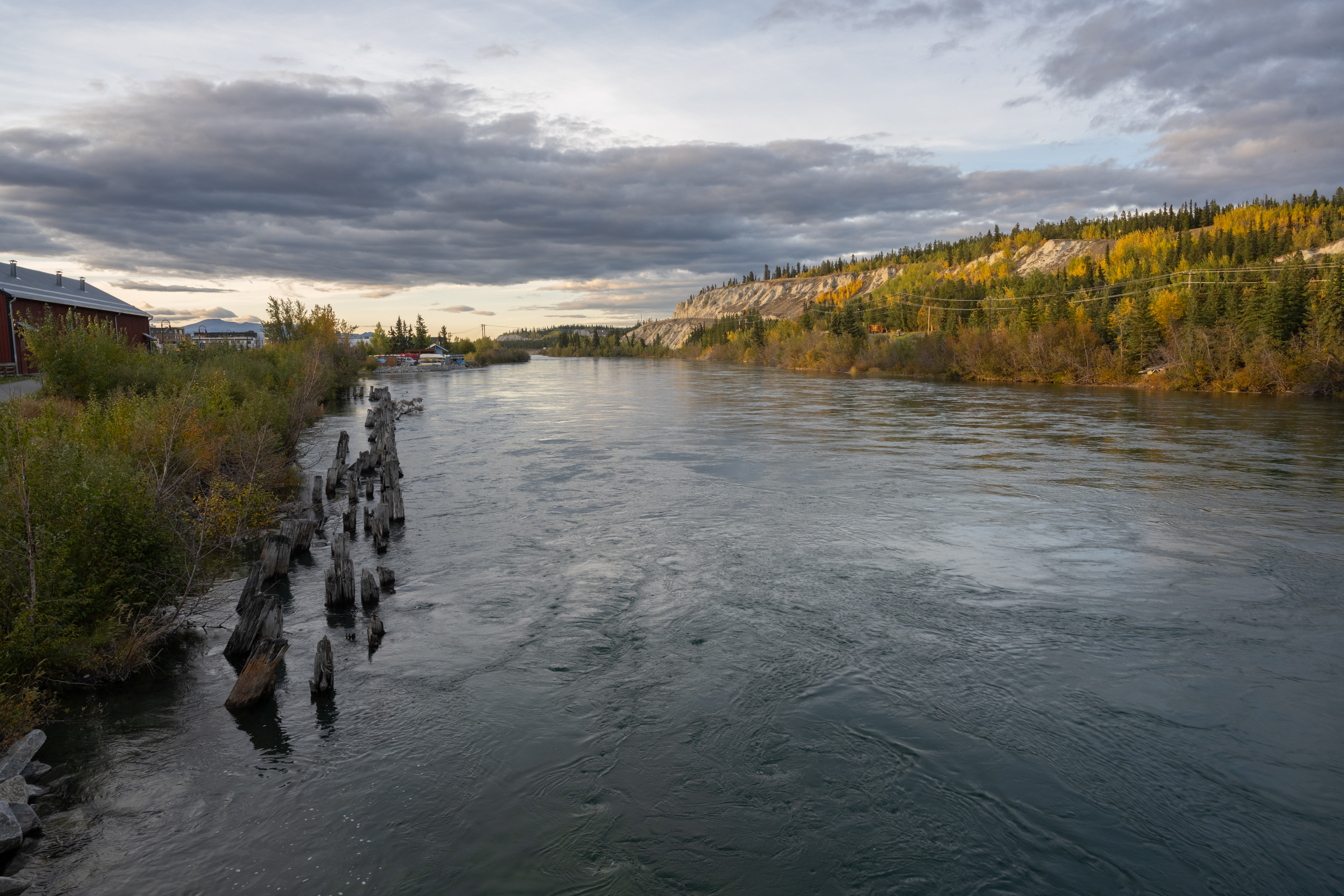
Another common meeting place that seems to connect Whitehorse in a different way is the Yukon River. 4 of the 5 people I ended up photographing in Whitehorse all took me to different places along the banks of the Yukon River, an impressive wonder that feels like a strong pulse running through the city. North America’s third longest river starts in the most remote, mountainous reaches of British Columbia, and tortuously winds through formidable landscapes of the Yukon, widening to braid itself across Alaska, before emptying into the Bering Sea.

Along its way, the river gives life to so many different communities, cultures and experiences of life along the way. Photo session experiences here ranged from new friends rollerskating on urbanized pedestrian bridges, learning about the sage that coated high, rocky banks (and got collected for my stale smelling road trip car!), and walking the tops of canyon edges that dove far and deep down to the river. Even in our society of modern day conveniences, the queer experiences I learned about here were from people who all felt inextricably connected to this place in their own way.

Thank you for keeping my company on this journey! If you’re enjoying the QueerVentures heading south, check out my next stop in Edmonton, Alberta, the Texas of the North.
Leave a Reply