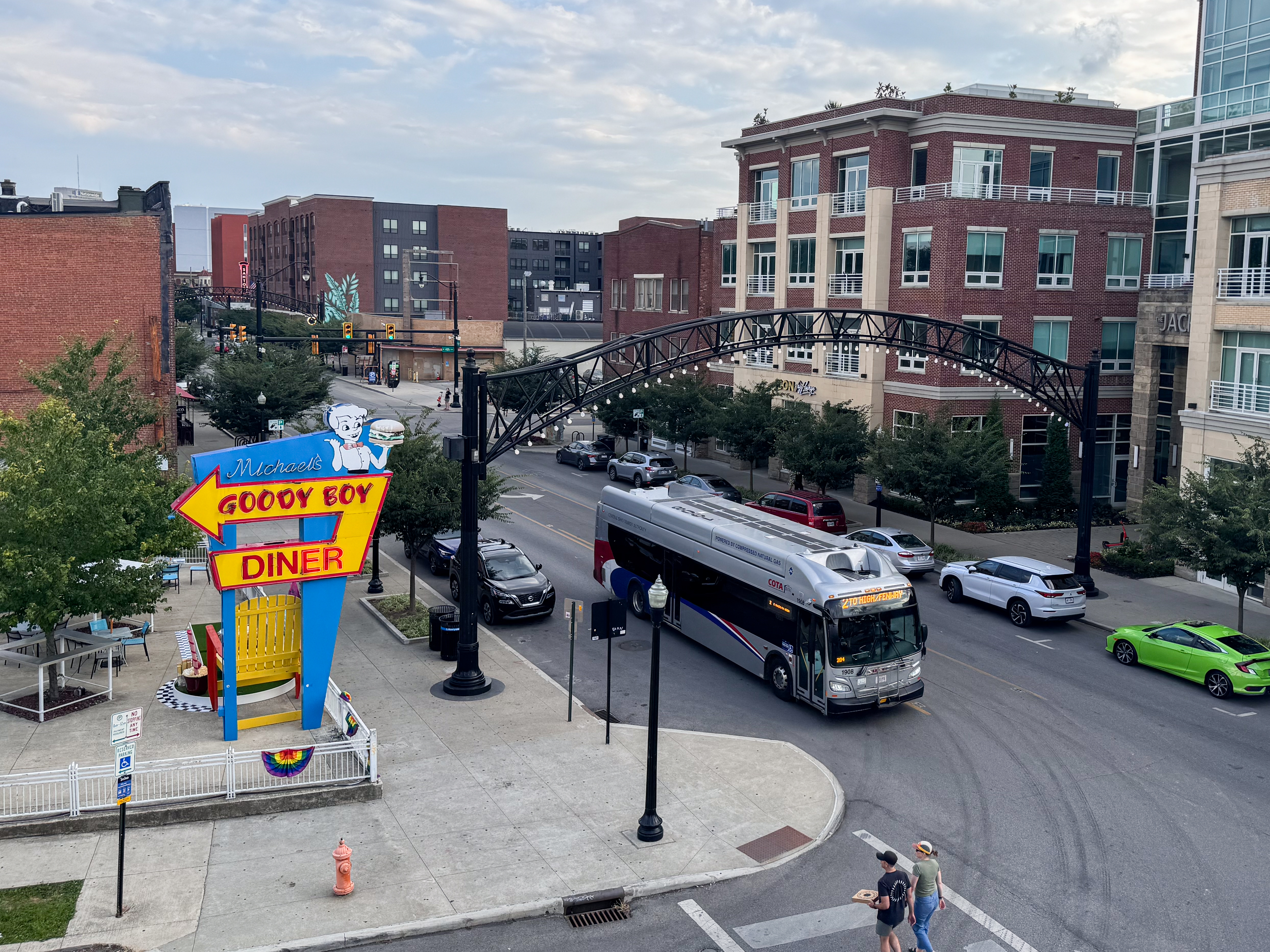
Why Columbus, Ohio?
Lately, I’ve been thinking more about the time I’ve spent with queer communities in and around Columbus, Ohio—especially as I’ve recently followed up with a couple folks I met in Columbus and nearby Dayton. More than a few people have curiously asked me why I’ve revisited the city a few times now, both for leisure trips and for the photo project.
My partner actually put Columbus on my radar, both for this project and for personal interest, wanting to share a city he genuinely enjoys. I won’t elaborate in great detail on his past situation, as he’s generally a more private person, but I do think it’s ironically relevant to why I keep returning to central Ohio—despite having no prior family or friend connections here.

A while ago, my partner got into a heated debate with a supervisor over—wait for it—pronouns. One of the hottest topics and social “crisis” of the 2020s. It was about my pronouns (they/them), and about the respectful treatment of LGBTQ employees and their diverse identities. The next day, he was briskly removed from his assignment and reassigned to central Ohio. We speculated it might’ve been a form of soft punishment.
On his first trip to central Ohio, he excitedly called me and said,
“Jayme, I wish you were here. This is the queerest city.”
The irony was not lost on me.
So, when I had the chance, I tagged along on future trips to Columbus. I don’t think it’s an exaggeration to say it might be one of the queerest cities I’ve visited in the Midwest—perhaps even rivaling Chicago’s queer scene. I’m sure more than a few locals might argue otherwise, particularly with their rights being viciously targeted by state politicians. But the vibe—anywhere inside the I-270 loop—just felt openly queer. From how people express themselves on the street, to the sheer number of businesses proudly supporting the LGBTQ+ community.
Outside that bubble, though, things felt different. My queer looks weren’t always welcome when I frequented businesses in the rural suburbs, and I saw that reflected in small interactions—and in the local news, like the repeated vandalism of rainbow-painted crosswalks in the suburbs.

Home to the (Second) Largest Pride Party in the Midwest
On a trip in July, we were walking around when I suddenly realized—every other person we passed looked queer – not that you can always tell … but sometimes we just know each other;) We popped into a Great Clips, where the supervisor/owner seemed openly gay, my stylist coded queer AND knew how to style a fabulous queer haircut.
We wandered past Stonewall Columbus, an LGBTQ+ organization with rainbows on the sidewalk and pride flags in the windows. It was after hours and looked dark and closed, but my cis-het partner excitedly jiggled the locked doors and peered inside —like he already belonged there. I can be more cautious regarding spaces I’ve never been in and am sometimes more on the antisocial side when I’m not doing photo sessions, so I urged him to move along. But a stranger opened the door and enthusiastically asked if we were there for the party.

My partner happily accepted the invitation—even though we were both hot, sticky, covered in prickly haircut clippings and not exactly dressed to impress.
Inside, about 70-80 people were gathered for a thank-you party for the volunteers who organized the second largest Pride event in the Midwest—right behind Chicago. It was a fun surprise to learn that the Stonewall Columbus Pride March and Festival, which started in 1981 with only 200 people, now drew impressively massive crowds of 700,000+.
Though we weren’t technically invited, everyone greeted us warmly and asked if we’d met before. We ended up having some great conversations with truly amazing people who didn’t hesitate to welcome total strangers.


Making New Safe Spaces in Columbus: The Intersection of Queerness, Sex Work, and Creative Arts
Columbus is full of queer spaces—but I collaborated with one group that stood out for creating a sanctuary for humans who are often pushed to society’s margins. The Autonomy Project is a nonprofit that intentionally creates beautiful, affirming spaces for queer creatives, kinksters, and people from all walks of life—including sex workers.
The Autonomy Project’s founder, Jamie, half-joked that the Venn diagram of these overlapping communities is basically a circle. These are all groups who struggle to find safety—physically and emotionally—without fear of being pushed out.

Jamie and their team foster self-discovery and connection through workshops, socials, and play parties. Their space is not a BDSM dungeon or swinger’s club—though those are safe havens for many. Jamie’s vision was different. They showed me through gorgeously curated rooms, thoughtfully designed to mix sex education, art, and culture. The space can host everything from intimate gatherings to full-on dance parties with a stage.
Jamie lovingly described their team as “outrageously queer.” I photographed some of their staff and members under their studio lights while hearing pieces of their stories for the photo project.

One quote from the Autonomy Project’s website felt particularly resonant to the mission of All the Genders Photo Project:
“Don’t let others box you into their idea of what they think you should be. A confined identity is a miserable way to exist.”

Merging Christian Faith with Queerness in the Heart of the Bible Belt
When I first started this project, I felt like I was holding my surprise when meeting the rare queer person with a deep and committed Christian faith. It wasn’t very common in Alaska, and extremely rare in Canada. But in places like Ohio, West Virginia, and Virginia, I’ve met many people who’ve reclaimed their queerness within Christianity.
Many of them have done intense healing work from religious trauma, and emerged with a renewed, joyful self-acceptance. I won’t dive too deep here—it’s a complex topic deserving its own post, and I personally have no interest in being part of a church, but I think it’s worth highlighting the intersection of queerness and Christianity in these regions … just because so many people don’t think the two can peacefully co-exist in the same being, and I’m sure there are queer folks out grasping for ways to merge their Christian roots with the rest of their spirit.

One person I met specifically chose to attend seminary outside Columbus because of its LGBTQ+ inclusiveness. Max shared a long journey of challenges and ultimately said:
“My spirituality is more expansive than what is offered in the church. It has taken me a long time to fully believe that my queer, trans, intersex identity is truly divine…”
Radical Body Acceptance
I’m calling this section “radical,” though I wish it weren’t. Self-acceptance of all bodies shouldn’t be radical—but under westernized American constructs, it is often considered radical. I learned something from the diverse experiences of every person I met in Columbus, but a photo session with Sharon particularly stuck with me. I’ll never forget their refreshing, unapologetic embodiment of self-love.

Many trans and genderqueer people describe long journeys of working through internalized transphobia, dysphoria, and so much more to find joy in their bodies. Sharon, a retired strongwoman, filled the space around her with a large and powerful body—one that doesn’t match mainstream ideas of femininity. I couldn’t help but think of my own mother, a large woman herself, who always seemed so weighed down with deep shame over her own body. Sharon felt like her quintessential opposite.

Sharon expressed: “I can’t identify with the trans plight. I mean when the government comes for us, I will be there fighting alongside trans people to protect all of us … because I’m categorized in this group…. But I’ve always loved my body.”
She described being intersex by medical standards, but doesn’t dwell on labels. She simply is. The aura of joy around her left me with no doubt that she spoke in earnest expressing her self-assuredness. Here’s part of what they wrote for their story:
“I have always had a big, strong body. No one close in my family or my friends ever made me be anything else. I grew up running free on the beach with the boys and the girls. I wore dresses or jeans as I pleased, and I jumped fences and rode bikes in both. Not that it was always sunshine and rainbows – no one is totally free from the pressures of the world to conform. There were, and continue to be things to learn and unlearn, things that feel sticky or wrong. I do my best to meet all those with openness and curiosity.
I never wanted to be a girl. I never wanted to be a boy. I’ve always walked diagonally back and forth across both roads, taking what I want and leaving what I don’t behind (to the extent that’s possible). Even when others question what I am— and in turn make me question what I am— I love my size and strength and how it lets me move through the world. I love my fat. I love the hair on my body. I love intensity and softness. I love makeup. I love dresses, flowing fabrics, bright colors, and rhinestones. I love mud, dirt, sweat, and how it feels to repair a machine with my own hands. I love my truck and sometimes I stink. None of these belong to a single gender experience. To me, gender is one of many sets of paint colors I have access to – another tool I can use to describe my experience of the world. These are the things I use to decorate my existence.”

Conclusion: Finding Light in Unexpected Places
Columbus may not have been on my radar at first, but this so-called “flyover” city has become a meaningful part of my journey with All the Genders. It’s not just the scale of Pride or the visible allyship in local businesses—it’s the people carving out nuanced, beautiful lives at the intersections of faith, queerness, sex work, creativity, and radical self-acceptance.
I’ll admit, I also needed repeat excuses to return to Jeni’s Ice Cream, originally founded in Columbus—but mostly, I’m excited to reconnect with the many folks here who are building something bold and necessary. This city has shown me that queerness flourishes in the Midwest—not just in defiance of its surroundings, but often because of the love and support people pour into each other.


Leave a Reply